









Cybersecurity can feel complex, but the reality is that most cyber threats fall into a handful of predictable categories. Understanding these categories helps organizations reduce uncertainty, simplify decision making, and focus on the controls that strengthen long-term resilience.
Below is a practical breakdown of the seven most common attack types affecting modern organizations. These patterns shape how security strategies are built and where risks most often appear.
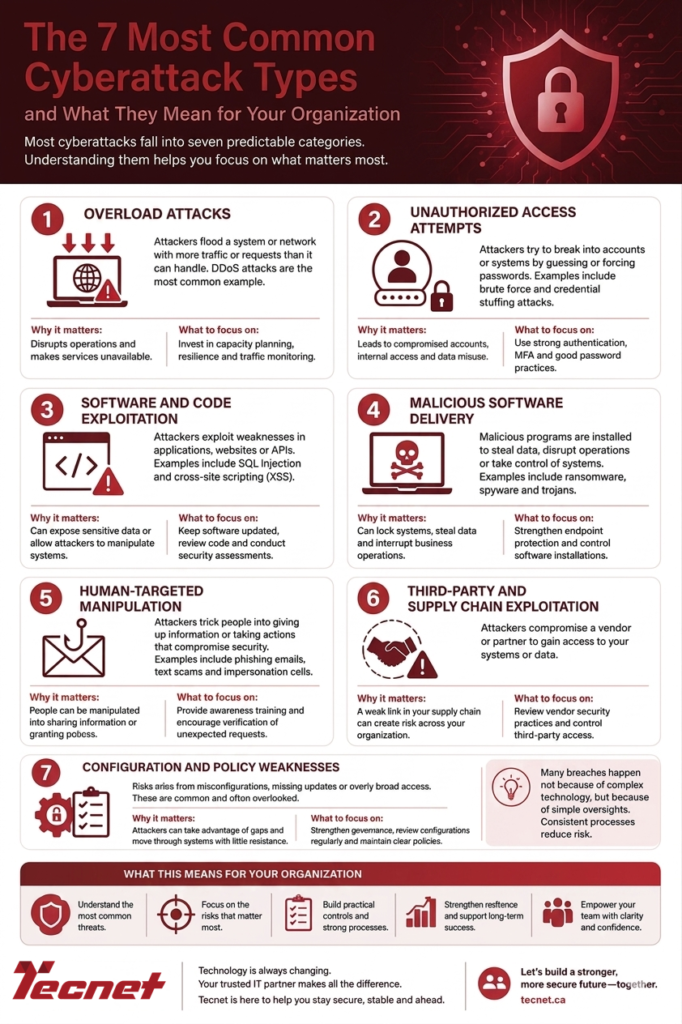
1. Overload Attacks
Overload attacks focus on overwhelming a system with excessive traffic or requests. One example is a DDoS attack, where a website or service becomes temporarily unavailable due to the volume of incoming connections.
Why this matters
These attacks disrupt operations and limit access to critical systems or customer-facing services. Even short periods of downtime can influence productivity and user experience.
What organizations should focus on
Invest in capacity planning, network resilience, and tools that detect unusual traffic volumes.
3. Software and Code Exploitation
Attackers look for weaknesses in applications, websites, or APIs. SQL injection and cross-site scripting are examples of this category.
Why this matters
Applications that are not regularly updated or reviewed may expose sensitive data or enable unwanted system behavior.
What organizations should focus on
Conduct regular patching, code reviews, and application security assessments.
4. Malicious Software Delivery
This category includes harmful software placed on devices or networks. Ransomware, spyware, and trojans are common types.
Why this matters
These tools can restrict access to systems, collect information, or interrupt business operations.
What organizations should focus on
Strengthen endpoint protection, update devices, and use strong controls around software installations.
5. Human-Targeted Manipulation
Instead of attacking systems directly, attackers try to influence people. Phishing emails, text messages, and impersonation calls fall into this group.
Why this matters
People make rapid decisions in daily workflows, which creates opportunities for attackers to request access or information.
What organizations should focus on
Provide clear staff training and empower teams to validate unexpected requests before responding.
6. Third-Party and Supply Chain Exploitation
Organizations rely on vendors, partners, and tools that connect into their environments. If a partner is compromised, the risk extends to everyone connected to them.
Why this matters
Third parties often have access that an attacker can use to reach internal systems or data.
What organizations should focus on
Review vendor security practices, confirm access levels, and apply consistent oversight across partners.
7. Configuration and Policy Weaknesses
Many breaches come from routine oversights, such as misconfigured cloud environments, missing updates, or overly broad user privileges.
Why this matters
These weaknesses give attackers opportunities to move through systems with little resistance.
What organizations should focus on
Strengthen governance, review configurations regularly, and maintain clear processes around identity and system management.
Turning Awareness Into Action
Understanding these seven categories helps leaders simplify the threat landscape and focus on the areas that have the highest impact. When organizations align their security programs to these patterns, they create an environment that is structured, predictable, and easier to maintain.
Security maturity grows through consistent improvement, reliable processes, and practical controls that staff can use with confidence. Tecnet supports organizations through this work by providing guidance, structure, and ongoing partnership that strengthens resilience over time.
How Tecnet Can Help
- Cybersecurity Assessment: We review your current security setup
- Customization: We tailor MFA to your organization’s needs
- Seamless Rollout: Step-by-step onboarding, training & support
- Ongoing Protection: Post-deployment monitoring & maintenance
Explore Tecnet’s Cybersecurity solutions designed for organizations of all sizes and learn how we can help you stay protected. Contact us today to book a Tecnet cybersecurity assessment to map your current environment, identify your highest-risk gaps, and get a clear starting point.