










Everyone Is Using AI. And You Don’t Know Which Tools.
Walk through any office today and you’ll find employees using AI. They’re summarizing meeting notes, drafting proposals, cleaning up data, and generating reports. AI has become a normal part of how work gets done.
The problem is not that your people are using AI. The problem is that most of them are using tools you never approved, on platforms you never vetted, with data you have no control over.
This is Shadow AI, and it’s quietly becoming one of the most significant security risks in your organization.
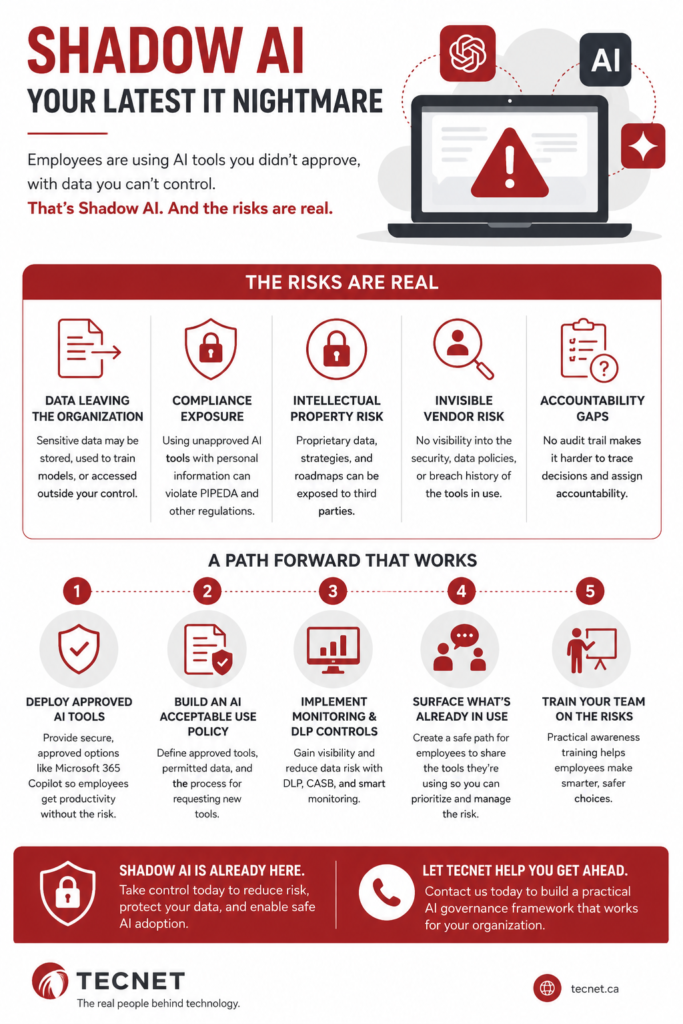
What Is Shadow AI?
Shadow AI refers to any AI tool used within an organization without the knowledge, approval, or oversight of IT. It is the AI version of a problem IT leaders already know well: Shadow IT, the practice of employees deploying software and services outside official channels.
The difference is scale and speed. Employees do not need to install software, request a license, or submit a ticket. They open a browser, sign up for a free account, and start feeding work data into a public AI platform in minutes. The barrier to entry is essentially zero.
Common examples include employees pasting contract language into ChatGPT to get a quick summary, uploading spreadsheets with customer data to an AI tool that “cleans” it, using browser-based AI assistants that read and process page content, running personal Claude or Gemini accounts for work tasks because the company has not provisioned a corporate alternative, and using AI-powered Chrome extensions that operate quietly in the background.
None of this is malicious. Most employees are simply trying to be more productive. But intent does not change the risk.
What the Risk Actually Looks Like
Shadow AI is not a hypothetical threat. The risks are concrete, and they fall into several categories.
#1 Data leaving the organization
When an employee pastes a contract, financial summary, or client record into a public AI platform, that data leaves your environment. Depending on the platform’s terms of service, it may be used to train future models, stored on servers in unknown jurisdictions, or accessible to the platform’s own employees under certain conditions. Your data loss prevention controls do not apply. Your audit logs show nothing.
#2 Compliance exposure
Canadian organizations handling personal information are subject to PIPEDA, and many sectors carry additional regulatory requirements. Feeding personally identifiable information into an unapproved third-party platform almost certainly violates your data handling obligations. In the event of a breach or audit, “an employee used a free AI tool” is not a defensible position.
#3 Intellectual property risk
Proprietary pricing models, product roadmaps, unreleased financial data, and internal strategy documents are all fair game when an employee uses an unsanctioned tool. Once that information is transmitted to a third-party AI platform, you have no meaningful control over what happens to it.
#4 Invisible vendor risk
Enterprise security teams evaluate vendors before onboarding them. Shadow AI bypasses this entirely. You have no visibility into the security posture of the platforms your employees are using, their data retention policies, or whether they have experienced their own breaches.
#5 Accountability gaps
If a decision was made based on AI-generated output from an unapproved tool, and that decision leads to a compliance issue or financial loss, tracing the chain of events becomes significantly more difficult. There is no audit trail.
Can You Lock It Down?
This is the question IT directors ask most often, and the honest answer is: not entirely.
Network-level controls like DNS filtering and firewall rules can block access to known AI platforms on corporate networks. But employees are not limited to corporate networks. They work from home, use mobile data, and often have both personal and work devices running side by side. A block on the office network does not prevent the same behaviour from happening on a personal laptop over a home connection.
Browser-based controls help, but browser AI extensions and built-in AI features in tools your organization already uses complicate the picture. Microsoft Edge Copilot, Google’s Gemini integration in Chrome, and AI features embedded in widely used SaaS platforms all represent potential exposure points that are difficult to block without creating significant friction for legitimate work.
The deeper issue is cultural and structural. Employees use Shadow AI because it is useful and because approved alternatives often do not exist yet. Blocking tools without providing sanctioned options tends to drive the behaviour underground rather than eliminate it.
A Path Forward That Actually Works
The goal is not zero AI usage outside IT’s view. That goal is unrealistic. The goal is visibility, control, and a clear framework that employees can follow.
Effective Shadow AI management starts with a few practical priorities.
Deploy approved AI tools
The most effective way to reduce Shadow AI is to give employees a sanctioned option that meets their needs. Microsoft 365 Copilot, for example, operates within your existing Microsoft security and compliance boundary. Employees get the productivity benefit; IT retains control. When there is a good approved option available, most employees will use it.
Build an AI acceptable use policy
Your acceptable use policy likely does not address AI tools specifically. It needs to. A clear policy defines which tools are approved, what data categories are permitted in AI interactions, and what the process is for requesting approval of a new tool. It does not need to be complex, but it needs to exist and be communicated.
Implement monitoring and DLP controls
Data loss prevention tools can be configured to flag or block the transmission of sensitive data types to unauthorized platforms. Combined with CASB (Cloud Access Security Broker) tooling, you can gain visibility into what AI services are being accessed across your environment, even when you cannot block them entirely.
Create a path for employees to surface what they are already using
An amnesty-style disclosure process, framed as an AI inventory exercise rather than a compliance investigation, can surface the Shadow AI already in use and help IT teams prioritize what to address first.
Train your team on the risks
Employees who understand why data governance matters are more likely to follow policy than employees who are simply told not to use certain tools. Brief, practical training on what Shadow AI is and why it creates risk goes a long way.
The Window Is Closing
Shadow AI is not a future problem. It is already inside your organization. The question is whether you address it on your terms or discover it after something goes wrong.
Organizations that move now, by building policy, deploying approved tools, and increasing visibility, will be in a significantly better position as AI adoption accelerates. Those that wait will face a more complex remediation effort and a larger potential exposure.
How Tecnet Can Help
Tecnet works with IT leaders to build practical AI governance frameworks that reduce risk without slowing down productivity. If you’re trying to get a clearer picture of what AI tools are in use across your organization, we can help.
- Cybersecurity Assessment: We review your current security setup
- Customization: We tailor MFA to your organization’s needs
- Seamless Rollout: Step-by-step onboarding, training & support
- Ongoing Protection: Post-deployment monitoring & maintenance
Explore Tecnet’s Cybersecurity solutions designed for organizations of all sizes and learn how we can help you stay protected. Contact us today to book a Tecnet cybersecurity assessment to map your current environment, identify your highest-risk gaps, and get a clear starting point.