







As organizations grow, technology grows with them, but not always at the same pace as internal resources.
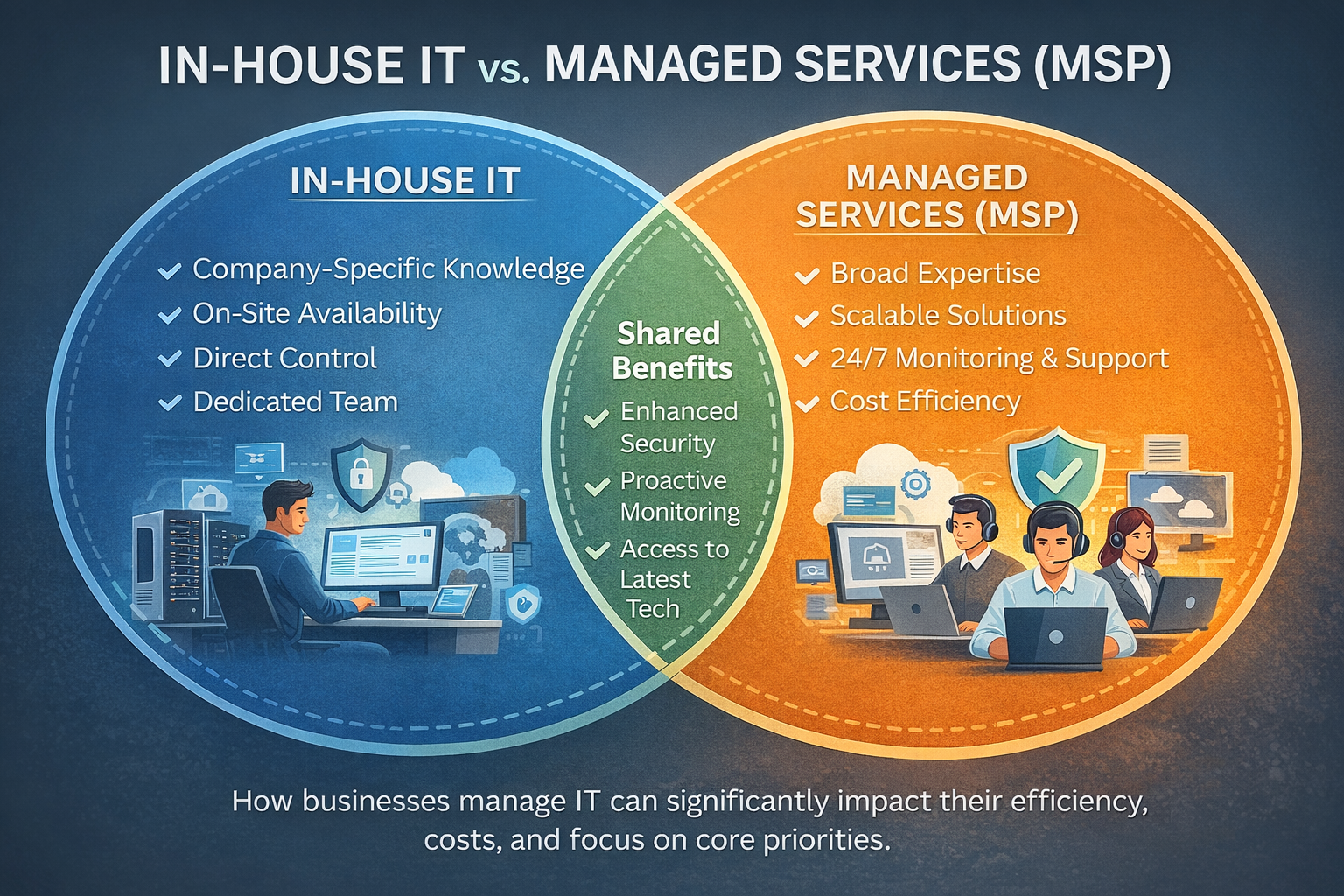
Today, the conversation isn’t about internal IT versus managed services, but about how the two can work together. Internal IT teams bring deep knowledge of the organization, while managed service providers add specialized expertise, scalability, and 24/7 support.
In this post, we’ll explore why more organizations are choosing a collaborative IT model, where internal teams focus on business priorities, and managed services provide the additional support needed to manage today’s increasingly complex technology landscape.
1. Organization Size Is Relative, But IT Complexity Is Universal
Whether you’re a growing team of ten or an established organization with hundreds of users, IT demands continue to expand.
Why this matters
Cloud platforms, cybersecurity, licensing, compliance, and AI all require specialized expertise.
- What feels “small” in headcount can still be “large” in technical complexity.
- Internal IT teams are often expected to wear too many hats.
IT challenges don’t scale linearly with staff size, they scale with technology.
2. Internal IT Brings Context—Managed Services Bring Scale
No individual technician can be an expert in everything, no matter how talented that individual is. A restaurant where the same person serves you, cooks the food, and does the dishes will have a very limited menu and you’re not likely to have the best experience. This is why we work in teams, with intersecting areas of specialization.
To have all the technical roles you would need to cover today’s broad scope of technologies, you would need to keep on staff dozens of your own employees. If you’re not one of those large multinational companies, this is difficult to justify the expense.
Internal IT teams are essential. They understand the business, the people, and the priorities.
What internal IT does best
- Deep knowledge of business operations and workflows
- Close relationships with users and leadership
- Strategic planning aligned with organizational goals
What managed services add
- Access to specialized expertise across multiple domains
- 24/7 monitoring and support
- Proven tools, processes, and best practices
3. Reducing Burnout and Single Points of Failure
So how do you know to hire someone with the appropriate experience and skills, if you’re not an expert in the technical aspects of the job itself? And, if they move on from your organization, how do you quickly back-fill the position and replace them without going through a painful transition?
Today’s IT landscape means staying on top of the latest trends, threats, and emerging products. It means purchasing expensive tools for monitoring, managing, and securing your technology. It means knowing which ones are best for your organization, how to implement them safely, and how to keep them secure and up-to-date.
Common challenges
- Vacation or sick leave coverage gaps
- Delays during incidents or outages
- Difficulty hiring or backfilling technical roles
- Constant context switching between support and strategy
How MSP support helps
- Shared responsibility and coverage
- Faster response times
- Reduced pressure on internal teams
- Continuity even during staff changes
4. How Managed Services Can Transform Business Outcomes
According to industry research, organizations that partner with Managed Service Providers (MSPs) see measurable improvements in efficiency, cost control, and overall business performance. By offloading day-to-day IT operations such as monitoring, maintenance, security, and updates, internal teams can focus on higher-value initiatives that directly support business goals.
Industry studies show that managed services can help organizations reduce IT operating costs by 25–45%, while improving operational efficiency and service reliability. In addition, one of the most cited benefits of managed services is the ability to free internal staff from reactive IT tasks, allowing them to focus on strategic priorities, innovation, and growth instead of constant troubleshooting. (KPMG, 2024)
Conclusion
The future of IT isn’t internal or outsourced, it’s collaborative.
By combining the deep organizational knowledge of internal IT teams with the scale and expertise of managed services, organizations can reduce risk, improve reliability, and stay focused on their core mission.
Managed services don’t replace internal IT, they strengthen it
Looking to better support your internal IT team?
Tecnet works alongside in-house teams to provide the expertise, coverage, and tools needed to manage today’s complex IT environments, without taking control away from your organization. Contact Us Today!