

For most business leaders, IT is somewhere between a background concern and a constant headache. When it works, nobody notices. When it doesn’t, everything stops.
The question isn’t whether technology matters to your organization. It clearly does. The real question is whether your current approach to IT support is actually built for stability and growth, or just for putting out fires.
That’s the conversation managed IT services opens up.
Download our PDF guide that covers the main points of Managed Service ->
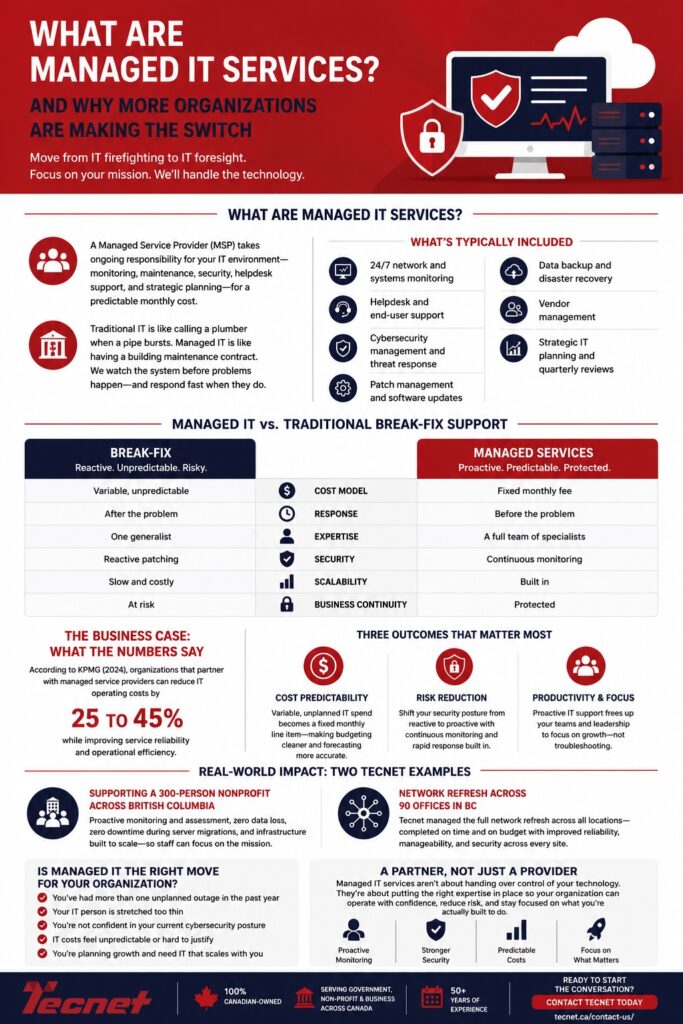
What Are Managed IT Services?
A Managed Service Provider (MSP) takes ongoing responsibility for your IT environment. That includes monitoring, maintenance, security, helpdesk support, and strategic planning, all delivered for a predictable monthly cost.
The simplest way to think about it: traditional IT support is like calling a plumber when a pipe bursts. Managed IT is like having a building maintenance contract. Someone is watching the system before anything goes wrong, and when something does come up, there’s already a team who knows your environment and can respond immediately.
See also: Understanding the True Value of Managed Services
What’s Typically Included in a Managed Services Agreement
- 24/7 network and systems monitoring
- Helpdesk and end-user support
- Cybersecurity management and threat response
- Patch management and software updates
- Data backup and disaster recovery
- Vendor management
- Strategic IT planning and quarterly reviews
Managed IT vs. Traditional Break-Fix Support
Break-fix is the model most organizations default to: something breaks, you call someone, you pay by the hour, they fix it, they leave. Simple enough on the surface.
The problem is the incentive structure. In a break-fix model, your IT provider only earns money when something goes wrong. There’s no motivation to prevent problems, no proactive monitoring, and no continuity. Every call starts from scratch.
How the Two Models Compare
| Break-Fix | Managed Services | |
| Cost model | Variable, unpredictable | Fixed monthly fee |
| Response | After the problem | Before the problem |
| Expertise | One generalist | A full team of specialists |
| Security | Reactive patching | Continuous monitoring |
| Scalability | Slow and costly | Built in |
| Business continuity | At risk | Protected |
The shift from break-fix to managed services is less about changing your IT vendor and more about changing your IT model entirely.
The Business Case: What the Numbers Say
This isn’t just an IT decision. It’s a financial and operational one.
According to KPMG (2024), organizations that partner with managed service providers can reduce IT operating costs by 25 to 45 percent, while improving service reliability and operational efficiency. That’s not a marginal improvement. That’s a structural change to how IT costs behave on your balance sheet.
For the Board and the C-Suite, Three Outcomes Matter Most
Cost predictability
Variable, unplanned IT spend becomes a fixed monthly line item. That makes budgeting cleaner, forecasting more accurate, and board conversations easier.
Risk reduction
Cybersecurity incidents are no longer a question of “if” for most organizations. The average cost of a data breach for small and mid-sized businesses has climbed significantly, and the reputational damage is harder to quantify. A managed services model shifts your security posture from reactive to proactive, with continuous monitoring, rapid threat response, and layered security controls.
Operational resilience
Downtime isn’t just inconvenient—it’s expensive. Managed IT services improve system uptime through proactive maintenance, real-time monitoring, and strategic guidance. Instead of scrambling when issues arise, organizations operate on a more stable foundation, with fewer interruptions and faster recovery times when incidents do occur.
Why More Organizations Are Making the Switch
The move to managed services has accelerated across industries—not just for large enterprises, but for small and mid-sized organizations as well. Three trends are driving this shift:
1. The Increasing Complexity of IT Environments
Modern organizations rely on a mix of cloud services, on-premise systems, mobile devices, remote work tools, and cybersecurity layers. Managing this environment requires specialized skills across networking, cloud architecture, cybersecurity, compliance, and more. A single in-house IT generalist can’t realistically cover all of it.
2. Rising Cybersecurity Threats
Threat actors are more sophisticated, automated attacks are more common, and regulatory pressures have increased. Organizations need continuous monitoring, end-to-end protection, and real-time response—capabilities that are difficult and costly to build internally.
3. The Demand for Predictable IT Costs
Unplanned IT failures lead to unplanned expenses. Managed services replace those spikes with a stable, forecastable cost structure, making it easier for leadership teams to manage budgets and allocate resources strategically.
What This Means for Your Organization
Switching to a managed services model isn’t just adopting a new vendor relationship. It’s adopting a new operational strategy—one where:
- IT becomes a driver of productivity instead of a source of disruption
- Risk is minimized through proactive security and monitoring
- Your internal team can stay focused on the mission, not troubleshooting
- Technology scales with your organization instead of holding it back
Ready to explore what a move to managed services would look like for your organization?
Moving to managed services is a meaningful change, but it’s a manageable one. The organizations that approach it with clear expectations, internal alignment, and a willingness to invest in a proper onboarding come out the other side with a more stable, more secure, and better-documented IT environment.
The shift from reactive to proactive isn’t just a service model change, it’s a maturity milestone. And with the right partner, it’s one that delivers measurable results.
Whether you’re experiencing constant outages, struggling with cybersecurity, or simply trying to modernize your systems, managed IT services provide a foundation designed for long-term stability and growth.
Learn more about our IT Managed Services, or contact us today to book your free IT Consultation